The bank was founded in 1931 in Mangalore by Attavara Balakrishna Shetty, an ardent Gandhian, freedom fighter, and minister in the erstwhile Madras Presidency and Madras state. The bank was founded to promote banking habit, thrift and enterpreneurship among the farming community of Dakshina Kannada district. The bank was founded on a Vijaya Dashami day, and so the name. The bank later shifted its head office to Bangalore. The bank was nationalized in 1980.
Attavara Balakrishna Shetty founder Vijaya BankVijaya Bank logo
On October 12, 1950, the name of Bengal Central Bank Limited (established in 1918 as Bengal Central Loan Company Limited, JC Das) was changed to United Bank of India Limited for the purpose of amalgamation and on December 18, 1950, Comilla Banking Corporation Limited (established in 1914, NC Datta), the Camilla Union Bank Limited (established in 1922, IB Dutt), the Hooghly Bank (established 1932, DN Mukherjee) stood amalgamated with the Bank. Subsequently, other banks namely, Cuttack Bank Limited, Tezpur Industrial Bank Limited, Hindusthan Mercantile Limited and Narang Bank of India Limited were merged with the Bank.
United Bank of India HistoryUnited Bank of India logo
Union Bank of India was established on 11th November 1919 with its headquarters in Mumbai. It was promoted by Seth Sitaram Poddar 1 and for the first three years was under European Management. The Head Office building of the Bank in Mumbai was inaugurated by Mahatma Gandhi, the Father of the nation in the year 1921, and he said on the occasion: “We should have the ability to carry on a big bank, to manage efficiently crore of rupees in the course of our national activities. Though we have not many banks amongst us, it does not follow that we are not capable of efficiently managing crore and tens of crore of rupees.”
Union Bank of India – Oldest LogoUnion-Bank-of-India old logounion-bank-of-India-Logo
Logo: The logo features two interlocking U’s in red and blue, stands for the consumer and the bank. The two U’s stand for union and the integrity, security and strength, which Union Bank of India stands for. The colour blue represents commitment, while red is symbolic of the passion that exists at Union Bank of India.
Tagline: Good people to bank with
Did you know: The bank had floating counters and an ATM on board INS Vikrant
Syndicate Bank was established in 1925 in Udupi, in coastal Karnataka as Canara Industrial and Banking Syndicate Limited, with a capital of Rs.8000/- by three visionaries – Sri Upendra Ananth Pai, a businessman, Sri Vaman Kudva, an engineer and Dr.T M A Pai, a physician – who shared a strong commitment to social welfare. Their objective was primarily to extend financial assistance to the local weavers who were crippled by a crisis in the handloom industry through mobilising small savings from the community. The bank collected as low as 2 annas daily at the doorsteps of the depositors through its agents under its Pigmy Deposit Scheme started in 1928. Thanks to this, Syndicate Bank was known as “Small man’s big bank”.
The bank was renamed as the Syndicate Bank Limited in 1954; also, the head office moved to Manipal. In 1969, the bank was nationalized along with 13 other banks.
Upendra Ananth Pai, cofounder, Syndicate BankVaman Kudva, cofounder, Syndicate BankDr.T M A Pai, cofounder, Syndicate Bank
The logo has changed through the years — the dog in the logo has become more prominent, and the color palette changed to orange.
Syndicate Bank Logo — one of the earlier logos
Syndicate Bank Logo OldSyndicate Bank logo
The dog in the logo is in sync with Syndicate Bank’s motto – ‘Faithful and Friendly’. The orange color indicates the Bank’s Vibrancy, competency and confidence to reach the next horizon of business; yellow indicates innovation, backing the vibrancy and quick decisions through collective work and thinking.
Way back in 1895, in Lahore, a group of visionaries and patriots — Lala Lajpat Rai, Mr. E C Jessawala, Babu Kali Prasono Roy, Lala Harkishan Lal and Sardar Dyal Singh Majithia and others — got together to create a national bank. The idea was first mooted by Rai Mool Raj of Arya Samaj who, as reported by Lala Lajpat Rai, had long cherished the idea that Indians should have a national bank of their own.
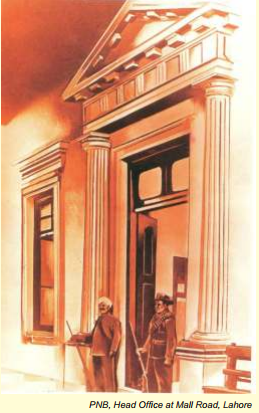
Punjab National Bank Head Office at Mall Road, Lahore
Punjab National Bank was born with an authorised total capital of Rs 2 lac and working capital of Rs 20,000.
Founders of Punjab National Bank
The first Board of 7 Directors comprised of Sardar Dayal Singh Majithia, who was also the founder of Dayal Singh College and the Tribune; Lala Lalchand one of the founders of DAV College and President of its Management Society; Kali Prosanna Roy, eminent Bengali pleader who was also the Chairman of the Reception committee of the Indian National Congress at its Lahore session in 1900; Lala Harkishan Lal who became widely known as the first industrialist of Punjab; EC Jessawala, a well known Parsi merchant and partner of Jamshedji & Co. of Lahore; Lala Prabhu Dayal, a leading Rais, merchant and philanthropist of Multan; Bakshi Jaishi Ram, an eminent Civil Lawyer of Lahore; and Lala Dholan Dass, a great banker, merchant and Rais of Amritsar. Thus a Bengali, Parsi, a Sikh and a few Hindus joined hands in a purely national and cosmopolitan spirit to found this Bank which opened its doors to the public on 12th of April 1895. They went about it with a Missionary Zeal. Sh. Dayal Singh Majithia was the first Chairman, Lala Harkishan Lal, the first secretary to the Board and Shri Bulaki Ram Shastri Barrister at Lahore, was appointed Manager.
33% of its offices in west Pakistan constituted 40% of its deposits — PNB had to lose these during partition. 15 of its employees died during the partition frenzy. The registered office was shifted to Delhi and the Bank honoured all the deposit claims of the refugees even on the basis of whatever little evidence they could produce.
Notice the old logo with elephants?
In 1951, the Bank took over the assets and liabilities of Bharat Bank Ltd. and became the second largest bank in the private sector. In 1962, it amalgamated the Indo-Commercial Bank with it.
Punjab National Bank was nationalized in 1969. In 1993, it acquired New Bank of India, a bank that was nationalized in 1980, the second wave of bank nationalization. Later in 2003, it acquired Kerala-based Nedungadi Bank, a private bank founded by Appu Nedungadi
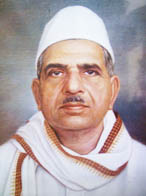
Lala Lajpat Rai is regarded as the ‘Founding Father’ of the bank.
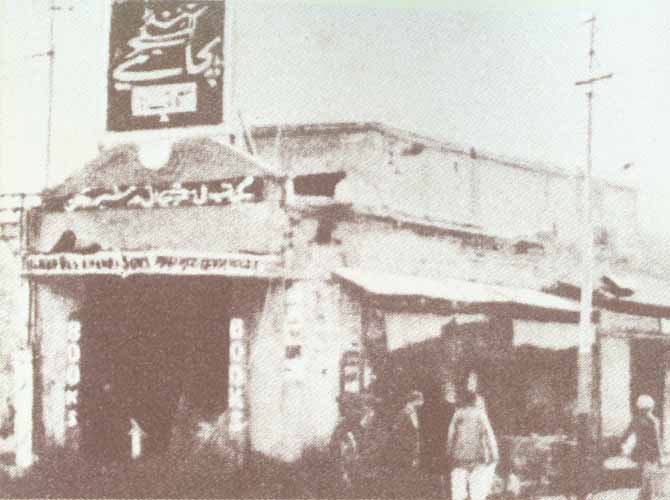
Lala Lajpat Rai, founding father, Punjab National BankThe first office of Punjab National Bank at Ganpatrai Road, Lahore
Did you know: “Stability” was this bank’s telegraphic address.
The Jallianwala Bagh Committee account was opened in the Bank in the late 1920s, which in the decade that followed, was operated by Mahatma Gandhi and Pandit Jawaharlal Nehru.
This bank was founded at Dongarakeri in Mangalore as the ‘Canara Bank Hindu Permanent Fund’ in 1906, by late Shri Ammembal Subba Rao Pai, a philanthropist. The fund grew into a limited company as ‘Canara Bank Ltd.’ in 1910 and became Canara Bank in 1969 after nationalization.
Canara Bank’s old logoAmmembal Subba Rao Pai, founder, Canara Bank
The brand identity for Canara Bank is based on the idea of a bond and is a representation of the close ties between the Bank and its many stakeholders – from customers and employees to investors, institutions and society at large.
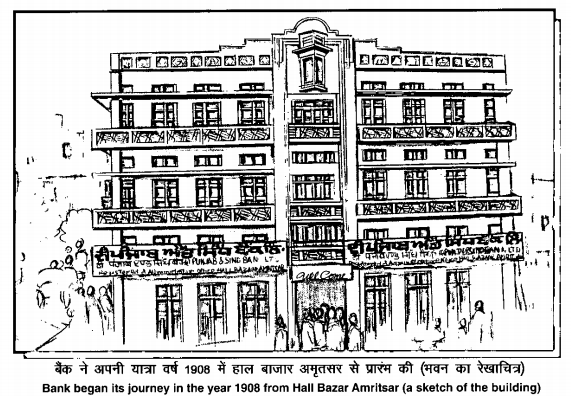
Bhai Vir Singh, Sir Sunder Singh Majitha and Sardar Tarlochan Singh aimed at uplifting the poorest of the the poor — and this lead to the formation of Punjab & Sind Bank in 1908, with its registered office situated at Hall Bazar, Amritsar, Punjab.The bank was nationalised in 1980.
Punjab and Sind Bank LogoPunjab & Sind Bank Hall Bazar Amritsar
Punjab & Sind Bank Cofounder Sardar Bhaivir SinghPunjab & Sind Bank Cofounder Sardar Tarlochan SinghPunjab & Sind Bank Cofounder Sunder Singh Ji Majithia
This bank was founded in Machilipatnam (Andhra Pradesh) in 1923 started by Dr Bhogaraju Pattabhi Sitaramayya, a prominent freedom fighter. The bank was nationalized in 1980.
Dr Bhogaraju Pattabhi Sitaramayya – FounderOld logo
Logo explained: The Symbol of Infinity denotes a bank that is prepared to do any thing, to go to any lengths, for the customer The blue pointer on the top represents the philosophy of a Bank that is always looking for growth and newer directions. The Key hole represents Safety and Security The Chain indicates togetherness The colours Red and Blue denote dynamism and solidity.
DOLLe, a friendly, intelligent, responsive dolphin is the bank’s mascot.
Dolle – Andhra Bank’s Mascot
Books by Sitaramayya: Feathers and Stones, The History of the Congress(1935), and Gandhi and Gandhism
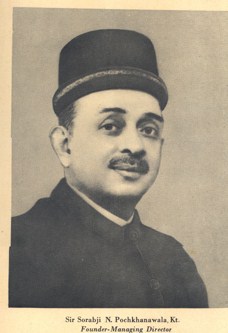
Established in 1911, Central Bank of India was the first Indian commercial bank which was wholly owned and managed by Indians. The establishment of the Bank was the ultimate realisation of the dream of Sir Sorabji Pochkhanawala, founder of the Bank. Sir Pherozesha Mehta was the first Chairman of a truly ‘Swadeshi Bank’. In fact, such was the extent of pride felt by Sir Sorabji Pochkhanawala that he proclaimed Central Bank of India as the ‘property of the nation and the country’s asset’. He also added that ‘Central Bank of India lives on people’s faith and regards itself as the people’s own bank’.
“No Indian is competent to manage a bank” was the opinion expressed by Mr. H. P. Stringfellow, the Manager of Bank of India in 1910, at the height of the swadeshi movement. He was quite naturally taken aback later that year when he was told that an assistant accountant in his own bank, twenty eight year old Sorabji Pochkhanawala, was planning to start a bank on his own.
Regarding this as a “huge joke” he called the young man into his office and advised him to abandon what seemed to him a “chimerical” scheme and to avoid taking any hasty decisions for atleast 24 hours. Mr. Pochkhanawala’s response was, “Sir, I have made up my mind. I resign from the Bank’s service. One day my bank will be bigger than yours.”Sorabji Pochkhanawala, though only twenty eight had been a banker for twelve years. He was the first Indian to be a certificated associate of the Institute of Bankers, London. Though he had discharged, when required, the duties of a Manager of a bank, he was not recognised as one. Nor was he given employment as “Manager” when he applied for that position at various banks such as the Bombay Merchants Bank because of the “deeply entrenched notion that ‘native gentlemen’ would be unable to conduct a bank according to western principles and that natives will not trust natives.” “Banking by Indians for Indians” became his driving obsession. He believed that unless all the executive functions were entrusted entirely to Indians, Indians would be discriminated against.On leaving Bank of India, Mr. Pochkhanawala with the support of a prominent cotton merchant, Mr. Kalianji Varadhman Jetsey rented premises formerly occupied by the Eastern Bank for Rs. 600 per month in the Gresham Building. He purchased two chairs and tables and began planning.The Bank’s first employee was Mr. Sorabji Vicaji as Chief Cashier at Rs. 500 per month.
Sir Sorabji Pochkhanawala, Founder, Central Bank of India
Central Bank of India logo
Central Bank of India – Logo Evolution
Mr. Pochkhanawala’s immediate family was shocked at his resigning from a secure job with ‘prospects’ and urged him to take back his resignation. Undeterred and with the support of Mr. Jetsey, he approached many prominent businessmen for their help to establish a bank. Mr. Munchershaw F. Khan, Mr. Kalianji Varadhman Jetsey, Mr. Ardeshir Bomanji Dubash, Mr. Manekji Jethabhai Varadhman, Mr. Moolji Haridas, Mr. Radhakison Lakmichand, Mr. Motilal Kanji, Mr. Haji Dawood Haji Elias and Mr. Jamsetji Hormusjee Chothia agreed to serve as directors. Mr. Kalianji Jetsey paid all the preliminary expenses. The memorandum and articles of association were drawn up and the Bank was registered on December 21, 1911. The birth of Central Bank of India is unique in Indian banking history. While other Indian banks were established by Englishmen or wealthy businessmen and managed by Europeans, this was the first bank established by Indians and managed by Indians.
Logo: The four Squares in the logo with bars that represent the Man, Finance, Industry and Nation evolving their two way effective interrelationship reflects the services rendered by the bank and its role in the economy [Source]
Corporation Bank came into being as Canara Banking Corporation (Udipi) Limited, on 12th March, 1906, in the temple town of Udupi, by the pioneering efforts of a group of visionaries lead by Khan Bahadur Haji Abdullah Haji Kasim Saheb Bahadur. They were committed to fulfill the long felt banking needs of the people and also to inculcate the habit of savings, provided the much-needed impetus to founding a financial institution that would bring about prosperity to the society. The Bank was the first to be established in South Canara with Udupi as its base. During this period, well known merchants, brokers and commission agents were Muslims and Abdullah was a respected representative of this community possessing keen insite and a lot of financial clout. The bank was nationalized in 1980.
Corporation Bank’s logoKhan Bahadur Haji Abdullah Haji Kasim Saheb Bahadur, founder Corporation Bank
Logo: The Bank’s motto “Sarve Janah Sukhino Bhavanthu” in Sanskrit, which means “Prosperity for All” is well-professed by the Bank in its day-to-day operations. The Bank’s logo has various components, namely Kamadhenu (denoting wish-fulfillment), Kalpatharu (eternity), Balance (justice for all), Wheel (industrial progress) and Wheat Grains (agricultural prosperity) which stand for universal prosperity and as a wish-fulfilling credo.