Indian Banks: The Story of Indian Bank

Indian Bank History

Indian Bank was started in the year 1907 and commenced banking operations on August 15, 1907.

In the aftermath of the crash of the Arbuthnot Bank, several things happened. Sir Arthur Lawley, Governor of Madras and himself a victim of the bankrupt company, launched a public fund to raise money to help the weaker sections who had lost everything in Arbuthnot’s. Amongst the scores of letters in The Hindu on the scandal, there was one from Dewan Bahadur R. Raghunatha Rao, a distinguished administrator and a prominent citizen, that suggested the starting of an Indian bank “now that European integrity and honesty (have come) under a cloud.” And the most constructive thing to come out of the scandal was when a young vakil, V. Krishnaswamy Iyer, later to become an eminent lawyer and High Court Judge but at the time just making his way up and acting on behalf of several Arbuthnot creditors, took his cue from the letter that appeared in The Hindu and set out with a will to promote an Indian bank. He got together eight other prominent citizens of Madras who also felt, in the words of the historian of the bank, R.K. Seshadri, “that a bank which depended on the savings of those in the South had to be incorporated locally and managed by the Indians who were locally known and respected”. Not one of the promoters was a Nagarathar though they were to provide a substantial part of the funding.

Indian Bank Founder V. Krishnaswamy Iyer
Dewan Bahadur S. Rm. M. Ramaswami Chettiar, director, Indian Bank
Dewan Bahadur S. Rm. M. Ramaswamy Chettiar, founder director, Indian Bank
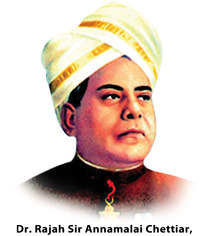
Rajah Annamalai Chettiar, Director, Indian Bank


With the cooperative bank’s focus on the cooperative movement, the capital of the Presidency, the chief city of the South, sorely lacked an Indian joint-stock bank. It was to remedy this that Krishnaswamy Iyer and his co-promoters sent out their first circular on November 2, 1906, inviting the public’s views on the possibility of starting “a Native Bank in Madras”.

The encouraging response they received prompted them to call a meeting at Krishnaswamy Iyer’s house. At this meeting it was decided to go ahead with plans to establish an Indian bank. What resulted was the Indian Bank Limited, which was registered on March 5, 1907 and opened its doors for business on August 15th.

From their very first circular it was clear that the promoters were relying on “the indigenous bankers” of South India, the Nattukottai Chettiars, for finance and the business acumen to found the bank and make a success of it. In the event, though there were only three Chettiars among the 22 who attended the historic meeting at the Mahajana Sabha Hall, the community rallied around its leaders and helped finance the bank and run it successfully till nationalisation changed bank administration.

The first directors of the bank were Lodd Govind Doss, Rm.M.St. Chidambaram Chettiar, Dewan Bahadur S.Rm.M. Ramaswamy Chettiar (uncle of Sir M.Ct. Muthiah Chettiar, and who the next year made way for his younger brother, Annamalai Chettiar, later the Rajah of Chettinad), T. Seetharama Chetty, Khan Bahadur Mohamed Abdul Azeez Badshah Saheb, who was the honorary Turkish Consul in Madras, Murledoss Ramdoss, V. Krishnaswamy Iyer, Dewan Bahadur M. Adinarayana Iyah and C. P. Ramaswamy Aiyar. Other directors who joined the Board later the same year were Dewan Bahadur Govindoss Chatoorbhoojadoss, Nalam Lakhsmi Kantaguru and P.M.A. Muthiah Chettiar.

Source

Indian_Bank_Logo
Indian Bank Logo

Logo: In keeping with the times, the Indian Bank’s new logo consisting of three circling arrows arranged around a central point was approved in July 1978. The three arrows stood respectively for Savings, Investment and Surplus. Saving leads to investment, investment to income, and income in turn to surplus or saving, in a circular chain, signifying ever-increasing prosperity. Source

Indian Bank - Cheque
Notice how the branding has changed?

Tagline: Your tech-friendly bank

Indian Banks: The Story of Bank of India

Bank of India

Bank of India was founded on 7th September, 1906 under the promotion of stalwarts like Sir Sassoon J. David, Sir Cowasji Jehangir (1st Baronet), Ratanji Dadabhoy Tata (JRD Tata’s father), Gordhandas Khatau, J.H Dani, Lalubhai Samaldas, Khetsey Khiasey, Ramnarain Hurnandrai, and Noordin Ebrahim Norrdin who became its first Directors. It commenced its operations from the Oriental Building on Esplanade Road, now the office of American Express Bank. Given the Swadeshi Movement roots of the bank, and its time of origin, the presence of Bharat Mata in its logo should not come as a surprise to anyone. The Bank was under private ownership and control till July 1969 when it was nationalised.

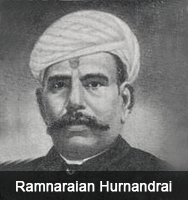
Ramnarain Hurnandrai - Co-founder, Bank of India
Ramnarain Hurnandrai – Co-founder, Bank of India
Sir Sassoon David -- Cofounder Bank of India
Sir Sassoon David — Co-founder Bank of India
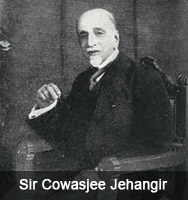
Sir Cowasjee Jehangir -- Cofounder, Bank of India
Sir Cowasjee Jehangir — Co-founder, Bank of India

The bank’s logo has a star with a Bharat Mata in the center.


Bank of India logo
Bank of India logo
Bank of India logo -- center -- Goddess and lion
Bank of India logo — Bharat Mata at the center

Tagline: Relationship beyond banking

Indian Banks: The Story of Indian Overseas Bank (IOB)

Indian Overseas Bank (IOB) History

Indian Overseas Bank (IOB) was founded on February 10th 1937, by Shri.M.Ct.M. Chidambaram Chettyar. MCt., as he was popularly known, was pioneer in many fields – Banking, Insurance and Industry. IOB was founded with the twin objectives of specialising in foreign exchange business and overseas banking. Beginning with United India Life Insurance, he ventured into general insurance in the form of United India Fire and General Insurance Company Ltd., and then the successful bank   — the Indian Overseas Bank. He also set up Travancore Rayons, India’s first synthetic fibre unit, in Kerala.

A little background:

Indian Bank, funded by Chettiar capital, was formed after the infamous Arthurbot crash. M.Ct. Muthiah Chettiar became a director of the bank in 1914 and remained one till his death when his son MCt succeeded him in 1930 and served on the board till 1940 and then again from 1945 to 1949 when his son, M.Ct. Muthiah, became a director. Differences of opinion with the board led to Muthiah quitting it in 1950. With that ended the MCt family’s association with helping steer the Indian Bank.

By the middle of the 19th century, Chettiar capital started migrating to Ceylon, Burma and further east, to expand their business in commodity trading. But while the Chettiars were active in South and Southeast Asia during this period banking facilities in their homeland, South India, continued to be inadequate.

The Indian Overseas Bank, though thought of by some as a `Chettiar bank’, adopted from its very inception an approach quite different to the Indian Bank’s in matters of business, customers and staffing. Not only did it see helping Indians overseas as a priority, but at home it began to look at India’s growing industrial sector, in which Chettiars had played only a small role, as an area where its presence should be. Indian Overseas Bank commenced operations simultaneously in Madras, Karaikudi, the chief town of Chettinad, and Rangoon on February 10, 1937.

It was the bank that put the country’s name on the map of banking in the Far East, lending assistance and prestige to hundreds and thousands of Indians abroad. In 1969, 15 years after MCt’s death, IOB became one of the youngest among the 14 banks nationalised.

Indian Overseas Bank Logo


Indian Overseas Bank founder M.Ct.M. Chidambaram Chettyar
Indian Overseas Bank - Cheque
Notice the old logo?

In 1973, IOB had to wind up its five Malaysian branches as the Banking law in Malaysia prohibited operation of foreign Government owned banks. This led to creation of United Asian Bank Berhad in which IOB had 16.67% of the paid up capital. In the same year Bharat Overseas Bank Ltd was created in India with 30% equity participation from IOB to take over IOB’s branch at Bangkok in Thailand. BhOB was merged with IOB in 2005. BhOB is owned by seven banks, including Indian Overseas Bank (30%). The others are The Bank of Rajasthan (16%), Vysya Bank (14.66%), Federal Bank (10.67%), Karur Vysya Bank (10%), South Indian Bank (10%) and Karnataka Bank (8.67%).

Bharat Overseas Bank logo

Tagline: Good people to grow with

Indian Banks: The Story of Dena Bank

Dena Bank History

Dena Bank was founded o­n 26th May, 1938 by the family of Devkaran Nanjee under the name Devkaran Nanjee Banking Company Ltd.  It became a Public Ltd. Company in December 1939 and later the name was changed to Dena Bank Ltd, the letters coming in from DEvkaran NAnjee. The bank was nationalized in 1969.

Dena Bank logo
Dena Bank logo
Devkaran Nanjee HM Mint 10 Tola Silver Bar

Logo: The logo of Dena Bank depicts Goddess Lakshmi, the Goddess of Wealth. It was the desire of the founding fathers of the Bank that the Bank should be a symbol of prosperity for all its clients, and the logo represents this promise. The contemporary ‘D’ in the logo reflects the dynamism, dedication and the drive towards customer satisfaction.

Indian Banks: The Story of Bank of Maharashtra

Bank of Maharashtra

Thanks to the tireless efforts of AR Bhat, founder of Mahratta Chamber of Commerce, the Bank of Maharashtra was registered on 16th September 1935 at Pune with an authorised capital of Rs.10.00 lakh by a group of visionaries with the objective of serving the common man who were till then neglected by the banking system.

Bank of Maharashtra Founders - First Meeting
Bank of Maharashtra Founders – First Meeting
Bank of Maharashtra Logo
AR Bhat - Bank of Maharashtra
AR Bhat – Bank of Maharashtra

Deepstambh, Maharashtra

The logo has a Deepstambh (Temple pillar) in the center. [Image: A typical deepastambh]

Tagline: Ek Parivaar Ek Bank

Source

Indian Banks: The Story of UCO Bank

UCO Bank History

United Commercial Bank Ltd. was founded by industrialist GD Birla in 1943, who after the historic “Quit India” movement in 1942 wanted to start a ‘truly Indian bank’. The bank was nationalized in 1969, and thus was born United Commercial Bank. In 1985, the bank’s name was shortened to UCO Bank.

UCO Bank Logo
UCO Bank Logo
GD Birla, Founder, UCO Bank


UCO Bank Logos Old and New


The bank’s logo has undergone metamorphosis through the ages. The 1943 logo had the Indian peninsula surrounded by the seas — this symbolized the vastness and unlimited scope of the bank. The hand with coins within the peninsula symbolized Goddess Lakshmi; the motor pump symbolized agricultural and industrial growth; the boat and ship in water on both the sides symbolized overseas trade to both the sides of the globe.

The 1958 logo of the bank had a lion, wheel, and an elephant taken from the Ashoka Pillar of Sarnath — this signified the Indian origins. The wavy water-line and the ship 1958 indicated that the river port, Kolkata, was the Head Office of the Bank. The ship represented commerce and the cog-wheels industry, both closely connected with banking. The lizard on the crest was taken from the flag of Kubera, the mythical God of Wealth, symbolized Money and Banking; the bezants on the right from the 15th-century Italian Bank of Medici symbolized lending and dealing with money.

The orange logo, adopted in 1973, had U with two hands upwards signifying progress. Orange — a mixture of red and yellow — had red’s dynamism, and yellow’s future and vibrancy. In 1983, an octagon with an inlaid square, and two uplifted hands with a coin in the middle were introduced. The coin in the hands signified security of the deposits, while the uplifted hands signified progress and aspirations. The color continued to be orange, conveying the warmth of cooperation, among other things.

In 1991, the color was changed to blue — a color that symbolized purity, and eternity, or integrity and continuity in the bank’s case.

Tagline: Honours Your Trust.

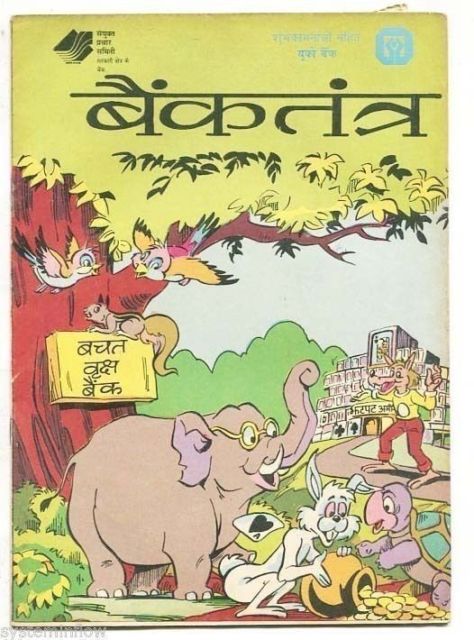
Did you know: The bank was associated with a comic series called Banktantra.

Banktantra Comics UCO Bank


Indian Banks: The Story of Bank of Baroda

Bank of Baroda History

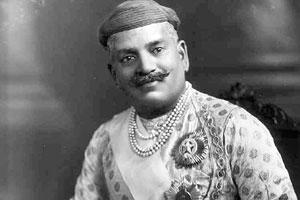
Bank of Baroda began as “The Bank of Baroda Limited”, in 1908 in Baroda. It was founded by the great visionary the late Maharaja of Baroda – Sir Sayajirao Gaekwad-III. On 18 July 1908, an auspicious day, the Maharaja took an elephant ride to a small rented office in the heart of the city. He arrived before 11 am, and deposited a silver plate filled with 101 gold coins – Bank of Baroda’s first deposit.

Sayajirao Gaekwad III - Founder, Bank of Baroda
Sayajirao Gaekwad III – Founder, Bank of Baroda
Bank of Baroda Old Logo
Bank of Baroda Logo
Bank of Baroda Logo

In 1953, the Bank opened its first overseas branch at Mombasa, Kenya. During the period 1953-1969, the Bank opened three branches in Fiji, five branches in Kenya, three branches in Uganda and one each in London and Guyana. Between 1969 to 1974, we established three branches in Mauritius, two branches in UK and one branch in Fiji. A significant development in the sphere of overseas operations was the entry of the Bank in the oil rich Gulf countries in 1974 when two branches were opened in UAE, one at Dubai and another at Abu Dhabi.

A committee in 1955 suggested that 10 state banks, including Bank of Baroda, should be amalgamated with State Bank of India. But Bank of Baroda had already expanded beyond the state, and even abroad. It handled no government business, as Baroda was now part of Bombay, and it was served by Imperial Bank of India. In 1959, The State Bank of India Subsidiaries Act was passed, and Bank of Baroda did not figure in the list to which the legislation was to apply.

The bank was nationalized in 1969.

Logo: The Baroda Sun

The logo is a unique representation of a universal symbol. It comprises dual ‘B’ letterforms that hold the rays of the rising sun. BoB call this the Baroda Sun. The sun is an excellent representation of what the Bank stands for. It is the single most powerful source of light and energy. Its far-reaching rays dispel darkness to illuminate everything they touch.

Tagline: India’s international bank

Indian Banks: The Story of Allahabad Bank

Welcome to TBQ’s Banks in India series. In this series, we will be covering the history of Nationalized, Scheduled, and Private banks in India — only the ones that are in business now.

Allahabad Bank

Allahabad Bank logo
Allahabad Bank logo

This bank, the oldest joint stock bank of the country, was founded in 1865 at Allahabad by a group of British pensioners. In 1920, the bank became a part of P & O Banking Corporation. In 1923, the bank shifted its headquarters and registered office to Kolkata (then Calcutta) for operational convenience. P&O Banking Corporation ran this bank as a separate entity. In 1927, the bank became a part of the Chartered Bank group, when Chartered Bank acquired the controlling interest in the P & O Banking Corporation. Allahabad Bank was nationalized in 1969.

The logo of Allahabad Bank signifies its city of origin — Allahabad. The logo symbolizes the confluence of three rivers (Triveni Sangam)– Ganga, Yamuna, and the mythical Saraswathi — at Allahabad.

Tagline: A tradition of trust

Allahabad Bank Cheque
Notice the branding?

Did you know: The in-house magazine of the bank is called ‘Triveni Dhara’.

Tata Crucible Corporate 2014 Cochin Prelims

Tata Crucible Corporate 2014 Cochin Prelims

Courtesy: Anil Raghavan

1)company shareholders liability is restricted to the original capital. Indicated by which term?
LTD

2)Mentholated cough drops owned by warner lambert & cadbury.
Halls

3)Company famous for aerial ads using blimps
Goodyear

4)Logos of thomas & uber cup.id the main sponsor
lining

5)financial tool used by banks to improve economy
Quantitative easing

6)MAC cosmetics was started by Frank toscan & frank angelo. MAC stands for?
Make up artists

7)Andrew tan is the 4th richest man in philippines. What is the liquor brand owned by him(relate to kings)
emperador

8)poster of 1942 movie starring bing crosby & fred astaire.Gave rise to what
Holiday inn

9)TTK’s 2012 condom brand
Skore

10)Third powerful indian according to some forbes list
Mukesh ambani

11)This forum is held in vienna in November from 2009.named after
peter drucker

12)old logo of uti bank

13)Devised by jimo’neill based on 6 emerging economies egypt,indonesia,s.africa,vietnam,columbia &turkey
CIVETS

14)Idiom concerning excess regulation of bureaucrats
Red tape

15)When dow jones started in 1885 the top firms belonged to
rail road

18)pic ben&jerry founders

17)Mobile phone named after replicants in blade runner
Nexus

18)question on kokuyo which became camlin

19)pic B.Ashok
IOC

20)pic jack ma

The story of Hello Kitty

The year was 1974. Yuko Shimizu, who was a designer working at Sanrio did something magical with a couple of simple strokes. Two dots for eyes, a tiny circle for a noise  — And was born Hello Kitty! Originally called Kitty White, the date of birth was chosen as November 1 as that was the Yuko Shimizu’s birthday. And two days ago, Hello Kitty turned 40!

Hello Kitty 40 years

The personified character’s ‘official records’ lists London as this feline’s place of birth.

Yuko Shimizu - Creator of Hello Kitty
Yuko Shimizu – Creator of Hello Kitty

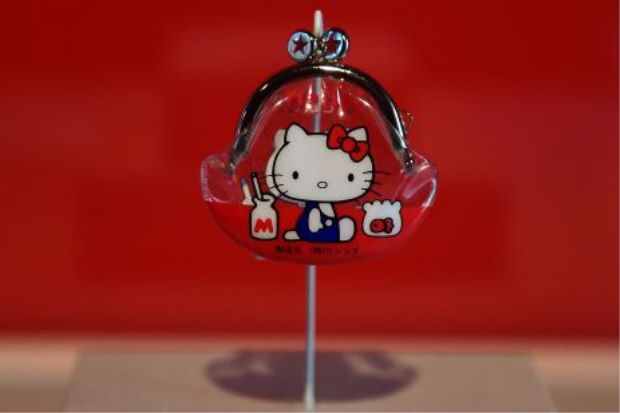
Back in 1974, she was a kitty sitting in blue overalls, and wearing a big red bow  — she was first spotted on coin purses targeted at Japanese girls.

The First Hello Kitty Item
The first Hello Kitty item, a small vinyl coin purse, which debuted in March 1975 in Japan is displayed at a press event ahead of the opening of the first ever Hello Kitty exhibition in North America, at the Japanese American National Museum in Los Angeles on Oct 10, 2014 [AFP]

The cute feline beauty has always been ahead of the curve and has adopted the latest social and fashion trends seamlessly, keeping the basic appearance more or less the same. Back in the 1970s, this Japanese character was defacto gifts among school girls in Japan. Hello Kitty started invading the US, and Europe during the second half of the ’70s. She posed piloting an airplane in 1978 for the opening of Tokyo’s Narita International Airport, symbolizing her dream of going global.

In the 1980s, Hello Kitty’s childish image was shed — it began attracting adults. Her outfits and background shifted from bold red, blue and yellow to hues of pink and blue. Kitty became mainstream during the ’80s — popular items like pagers and hand-held devices had her on them.

By the ’90s, Hello Kitty’s second generation fans were in. Sanrio opened Sanrio Puroland (and later another one, Harmonyland)– a theme park targeting families — in the Tokyo suburbs. A baby kitty was born in 1999. “Kitty-lers” — a new breed of grown-ups devoted to Hello Kitty — became a national phenomenon. A Hello Kitty laptop went on sale, as did a portable karaoke machine amid a karaoke boom.
Japanese animation and comics gained worldwide popularity during the 2000s, and Hello Kitty’s influence grew even larger. This cute-cool character donned a Dior collection in Vogue magazine. She also co-branded with Diesel, A Bathing Ape, Undercover, Reebok and Vans, as well as cosmetics makers Crabtree & Evelyn and MAC.


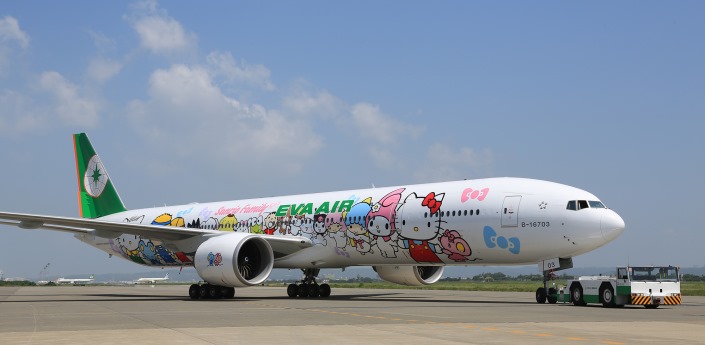
A EVA Hello Kitty Boeing 777 Jet
Taiwanese airlines, EVA flies Hello Kitty jets. Yes jets with Hello Kitty liverie, boarding pass, seat headrest, and even air hostess’ aprons!

How popular is Hello Kitty now? 50,000 — that’s the number of items on which you can see Hello Kitty — from cheques, to Visa and Mastercard cards, from jewelry to establishments Kitty is all around. 130 — that’s the number of countries where you can see her. Remember Lady Gaga performance in Hello Kitty costumes? Taiwan’s EVA Air flies Kitty-inspired Airbus jets. Yes jets with Hello Kitty liverie, boarding pass, seat headrest, and even air hostess’ aprons! Bangkok and Dubai have Kitty-themed luxury spas.

Hello Kitty is now safe in the hands of her third designer, Yuko Yamaguchi who’s taking her to newer heights.

Happy birthday, Hello Kitty!